Check an AI reviewer or exam before publishing
A practical review pass for source accuracy, calculations, answer choices, and privacy.
AI-assisted writing. Feature steps checked against StudySoda’s current editor, study screens, and API contracts. Our editorial approach
Treat a polished explanation as a claim to check. Correct content, a valid answer key, and deliberate visibility matter more than fluent wording.
Compare the draft with the source
Open a completed job with Review in editor and keep its source nearby. Read the title and outline first: does the draft cover the requested lesson, and has it added a topic your source never supported? Remove unsupported additions or supply a reliable reference before keeping them.
Check definitions and exceptions sentence by sentence. A summary that says “always use 360 days” has changed the lesson if the source distinguishes ordinary from exact interest. Highlighting and confident prose do not make that simplification correct.
Keep the useful source reference with the finished material. Do not invent an author, page number, teacher approval, or review credential. If a fact remains uncertain, resolve it before publishing a question that marks another answer wrong.
Solve numerical questions independently
Work each calculation without looking at the supplied answer first. Write the known values, convert units, substitute into the formula, and round at the requested stage. Compare the result with both the selected choice and the explanation.
For example, $4,800 at 7.5% annual simple interest for four months gives I = 4,800 × 0.075 × 4/12 = $120. The maturity value is $4,920. A question asking for interest must select $120 even if its explanation happens to mention the correct maturity value too.
Check that any stated convention is sufficient to obtain one result. Day counts, compounding frequency, rounding precision, and whether a rate is nominal or effective can all change an answer. Add missing conditions to the question rather than hiding them only in its explanation.
Check cards and choices as learning tasks
For flashcards, read the front alone. It should ask one clear thing and contain enough context to answer. “What is the rate?” is weak if the necessary example appears only on the back. Split cards that combine several unrelated definitions.
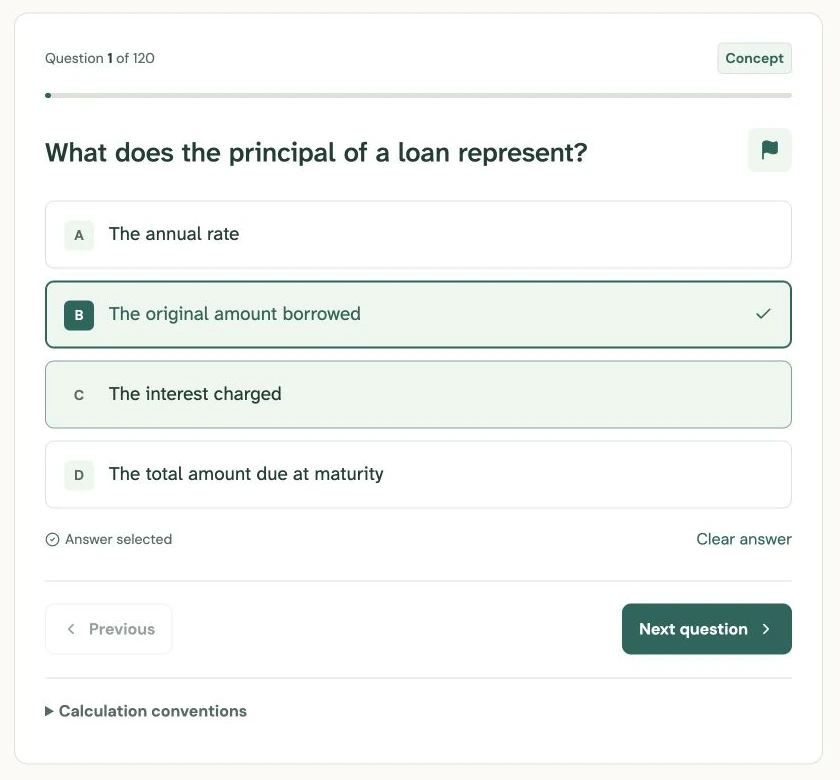
For exams, verify that exactly one choice is correct under the question’s stated assumptions. Remove duplicate options, accidental clues, and explanations that refer to the wrong choice letter. Plausible distractors can reflect common mistakes, such as using four years instead of four months, but should not create ambiguity.
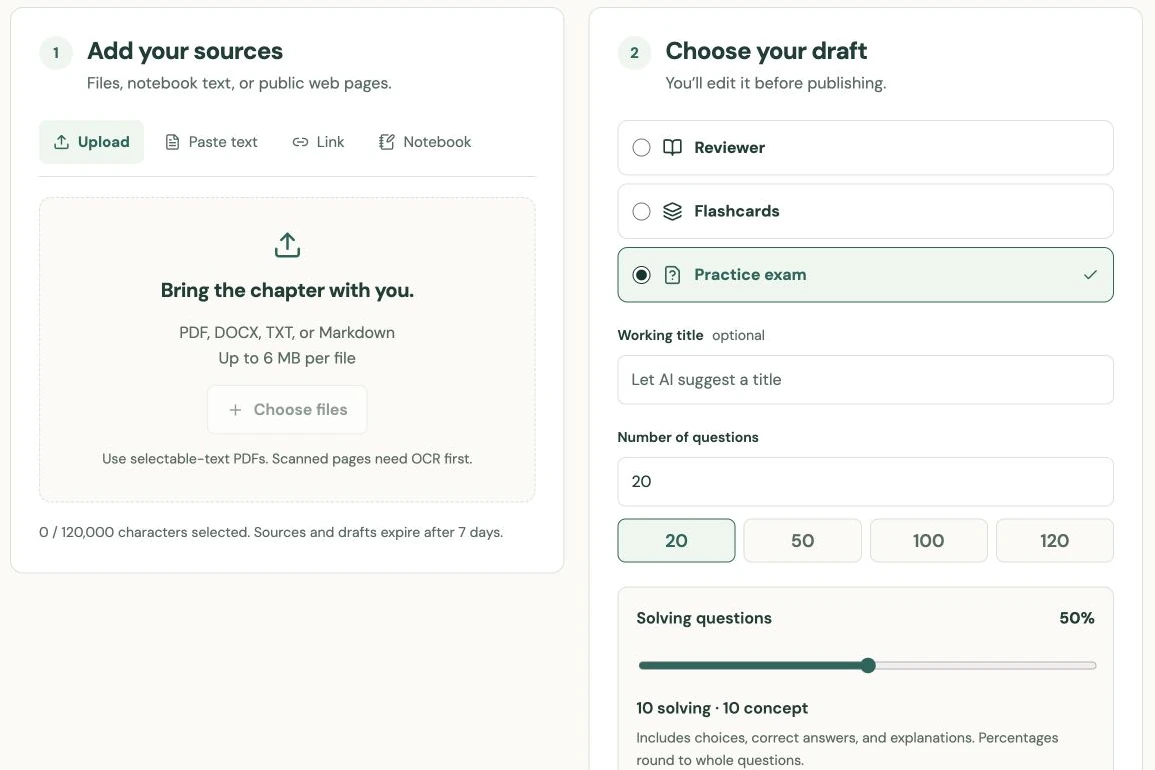
Read the entire set for repetition and coverage. Ten slightly reworded definitions do not test ten different ideas. Balance recall with the worked methods you actually want to practice; the requested AI question mix is a starting point for this editorial check.
Preview, check privacy, then publish
Use the editor preview to check headings, tables, links, and mathematical symbols. On a narrow screen, make sure a learner can still distinguish the prompt, choices, and feedback. Correct awkward wording that could change the meaning of a question.
In Review & publish, verify the title, topic, and visibility. Public is the default and uses your display name; Private requires Pro. Remove personal data and material you do not have permission to share before publishing publicly. An AI draft being private to your workflow does not automatically make its eventual material private.
After saving, open the material itself and make a short study pass. If you later correct a question, remember that an already started exam uses its saved snapshot; an old result is not proof that the current version is still wrong. Keep the notebook or source as your reference for future edits.
Put it into practice.
Review your draftsFurther help
- Create a mock exam
Question conventions, worked solutions, and publishing checks.
- Editorial approach
How StudySoda distinguishes guidance, sources, and AI assistance.